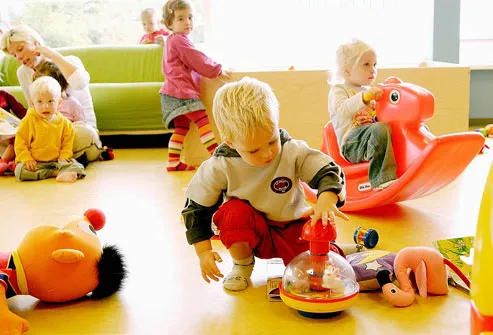
The most important role that the child care provider does is to help in guiding children's behavior in positive, supportive, and age-appropriate ways. The most appropriate ways to guide behavior are different at different ages, depending on their developmental abilities and needs.
An article in DailyMail discusses about the behavioral problems that kids faces during childcare and their development in childcare centers.
http://ecdc.syr.edu/wp-content/uploads/2013/01/Guiding-Your-Childs-Behavior.pdf
https://www.extension.org/pages/25703/basic-tips-child-care-providers-can-use-to-guide-childrens-behavior#.U_XR0vmSw6c
http://www.hanen.org/Helpful-Info/Articles/Does-child-care-make-a-difference-to-childrens-de.aspx
An article in DailyMail discusses about the behavioral problems that kids faces during childcare and their development in childcare centers.
- Those who spend less time with their mothers may suffer
- Those who spend more time in day care are more likely to be hyperactive
- Children cared for by child minders are more likely to have peer problems
- Child is trying to get a real need met but does not know how to communicate to the parents.
- When child seeks attention .
- When the child is too young to follow rules. Rules are unclear or inconsistent or too much expectations for the future of young child.
- Child is stressed or has strong emotions; frustrated, angry, overwhelmed.
- Change can be stressful, even when it is a positive change.
- Young children do not understand time well and waiting five minutes can seem like forever, that is why it is hard to finish up a fun activity and why they cry when you leave them at child care.
- Convey dos and dont's to children.
- Do not pay much attention to the kid's minor problems.
- Tell directly to child what you want to convey to them by facing them eye to eye .
- Give them enough time to do the task you have assigned them to do.
- Praise your child for cooperating with you and reward them so that it will become a positive and continuous activity in the kid's mind.
- Act quickly when problem behavior occurs, gain their attention, and tell them what you would like them to do.
- Repeat your instruction only once and provide logical, timely consequences that fit the situation.
- Setting up a good example.
- Give clear and simple choices.
- Keep rules that are easy and simple for the kids to understand.
- Active listening is another tool for helping young children cope with their emotions .
- Keep promises – Stick to the agreement .
- Give your kid some small activities and house work so that they both enjoy and feel important and also feel a sense of pride in oneself.
- Humor and fun should be incorporated in to your kids life so that it will help them have a positive behavior and attitude.
- Children who attend child care have better outcomes than children who are cared for at home by their mothers
- It doesn’t matter which child care a child goes to since most are of high quality
- Children with special needs have better outcomes when they are enrolled in child care
- Children with special needs should be enrolled in child care from a very young age to benefit their development
http://ecdc.syr.edu/wp-content/uploads/2013/01/Guiding-Your-Childs-Behavior.pdf
https://www.extension.org/pages/25703/basic-tips-child-care-providers-can-use-to-guide-childrens-behavior#.U_XR0vmSw6c
http://www.hanen.org/Helpful-Info/Articles/Does-child-care-make-a-difference-to-childrens-de.aspx